






|
Reptile Care at Parrish Creek
Husbandry For all the staggering variety of reptiles
available as pets, all reptiles have exacting needs as to diet,
temperature, light, and humidity. The specific requirements vary
from one species to another. As part of your visit to Parrish Creek,
we will provide you with detailed information as to your own
reptile’s needs, and suggest ways to provide the best environment
for your pet to survive and thrive. Recommendations One thing all reptiles have in common is that
they hide their symptoms – that is, they do their best to look
strong and healthy, even if they are sick. While this instinct
protects them from predators in the wild, it also means their
medical problems may go unnoticed in our homes – in some cases until
it is too late. So, to protect your pet, Parrish Creek Veterinary
Clinic recommends that all reptiles receive a comprehensive physical
examination and a complete blood work-up annually, in order to
detect and treat any medical problems as early as possible. Zoonosis The most important zoonotic disease (a disease
that animals can pass on to people) in reptiles is Salmonella. This
is a bacteria that most reptiles harbor as a part of their normal
bacterial flora. Humans can get sick from this bacteria by
accidently ingesting it. To prevent this, we recommend always
washing your hands after handling your reptile. Never allow your
reptile to have access to food preparation or eating areas. Be
especially aware of this disease potential when children are
handling reptiles. If you have questions or concerns about
Salmonella and your reptile, please call us. Services In order to diagnose and treat your reptile’s medical problems, Parrish Creek has many resources available on-site, including: · An in-house laboratory, where we can analyze your pet’s blood chemistries, test for parasites, analyze tissue and other samples, and perform many other procedures in minutes · Radiography (X-rays) · Ultrasound
·
Endoscopy · An in-house pharmacy
·
A modern surgical suite, where we can perform sterile
surgical procedures (including electrosurgery or cryosurgery –
freezing – if needed) with rigorous anesthetic monitoring by trained
doctors and technicians Teko’s story
|
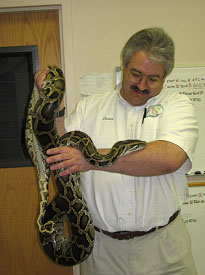 No
exotic pet practice would be complete without seeing lots of
reptiles – lizards and snakes, turtles and tortoises. Over the
years, Parrish Creek Veterinary Clinic has seen several hundred
bearded dragons, boas, box turtles, chameleons, chuckwallas, corn
snakes, geckos, iguanas, pythons, Russian tortoises, sliders,
sulcatta tortoises, tegus, uromastyx, water dragons, wood turtles,
and other scaly friends. Our doctor and technicians receive ongoing
training in the care and treatment of these fascinating species.
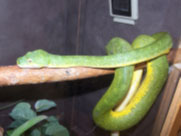
No
exotic pet practice would be complete without seeing lots of
reptiles – lizards and snakes, turtles and tortoises. Over the
years, Parrish Creek Veterinary Clinic has seen several hundred
bearded dragons, boas, box turtles, chameleons, chuckwallas, corn
snakes, geckos, iguanas, pythons, Russian tortoises, sliders,
sulcatta tortoises, tegus, uromastyx, water dragons, wood turtles,
and other scaly friends. Our doctor and technicians receive ongoing
training in the care and treatment of these fascinating species.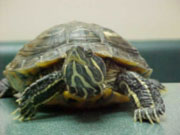
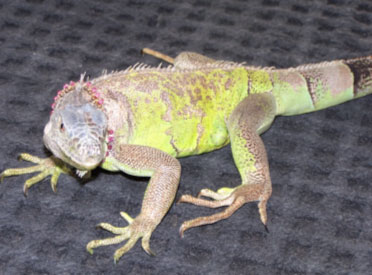 Teko
is a two-and-a-half-year-old green iguana, who has been a patient at
Parrish Creek since she was only two months old. In April 2007,
Teko was diagnosed with lymphoma, a type of cancer. After a visit
to cancer specialists at the veterinary college at Colorado State
University, where she received radiation and began chemotherapy,
Teko has returned to Parrish Creek every week since, to continue her
chemotherapy and monitor her progress. Now nearly a year after
Teko’s diagnosis (as of this writing), her owner likes to point out,
“She doesn’t think anything is wrong with her.” After several major
surgeries at Parrish Creek and with ongoing chemotherapy, Teko is
still growing up and going strong!
Teko
is a two-and-a-half-year-old green iguana, who has been a patient at
Parrish Creek since she was only two months old. In April 2007,
Teko was diagnosed with lymphoma, a type of cancer. After a visit
to cancer specialists at the veterinary college at Colorado State
University, where she received radiation and began chemotherapy,
Teko has returned to Parrish Creek every week since, to continue her
chemotherapy and monitor her progress. Now nearly a year after
Teko’s diagnosis (as of this writing), her owner likes to point out,
“She doesn’t think anything is wrong with her.” After several major
surgeries at Parrish Creek and with ongoing chemotherapy, Teko is
still growing up and going strong!
